Check out this video profile of SNC Art student Kyler Lasee and see the impact of the Art program at St. Norbert College. As Kyler says, “Around every corner, there is someone in your corner.”
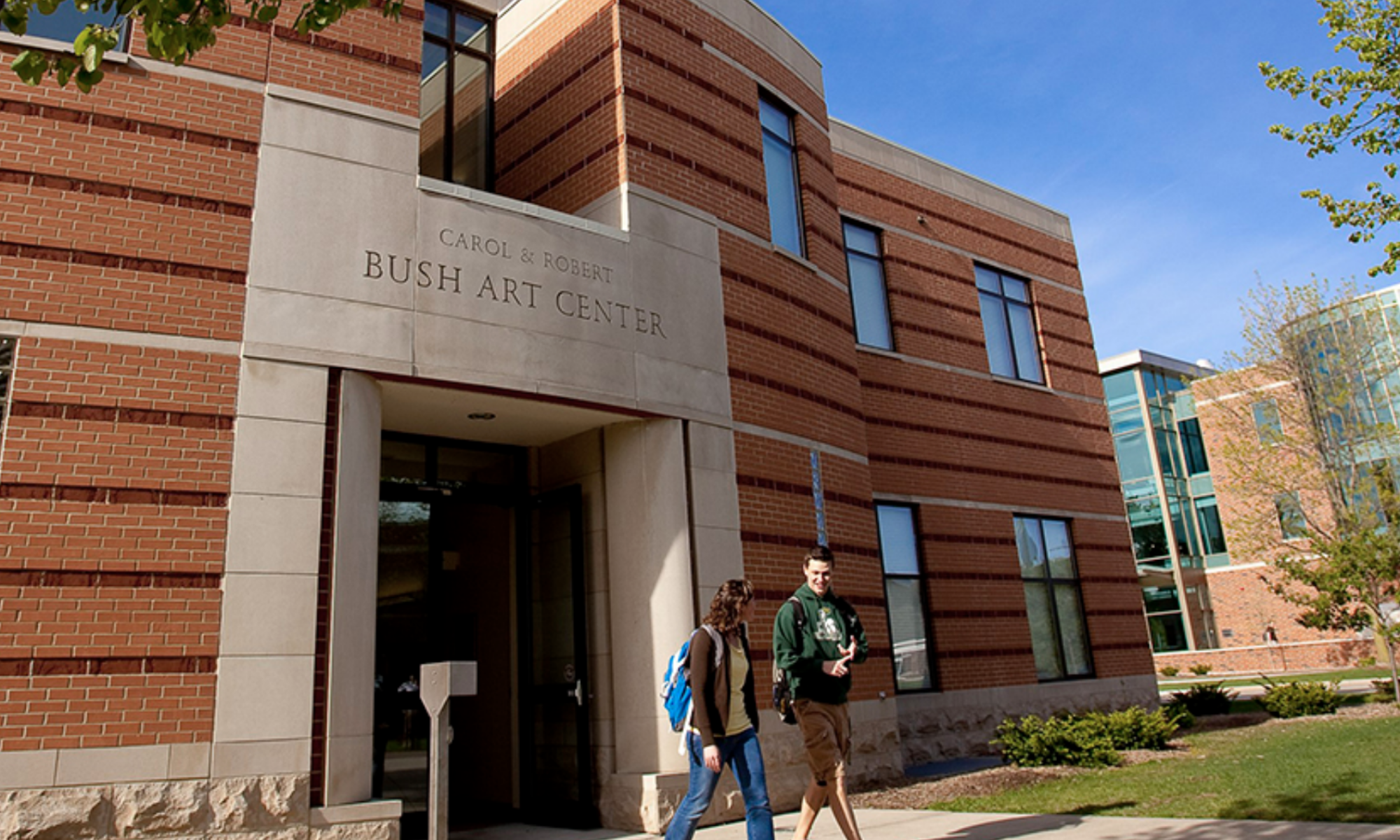
This fall, the Bush Art Center Galleries at St. Norbert College present a series of exhibitions exploring the relationships between art, democracy, human rights, justice, and civic participation. Together, these exhibitions demonstrate the power of art to foster reflection, dialogue, and public engagement while examining the ways individuals and communities navigate questions of freedom, rights, belonging, and collective responsibility.
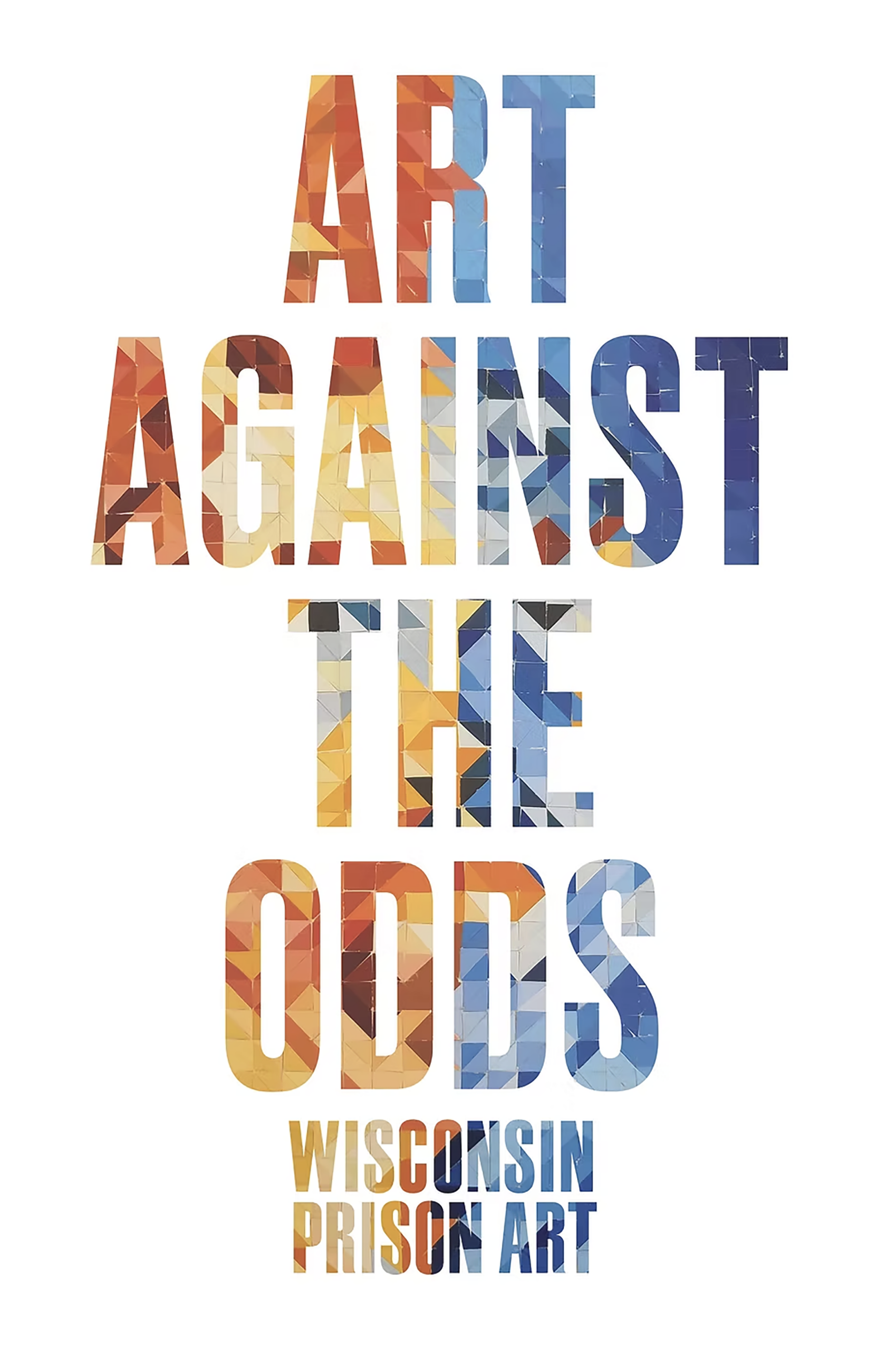
Art Against the Odds
Art Against the Odds features work by artists who are currently or formerly incarcerated within Wisconsin’s justice system. Highlighting the creativity, resilience, and diverse experiences of artists impacted by incarceration, the exhibition invites viewers to consider the intersections of art, justice, human dignity, and self-expression.
The exhibition also marks the establishment of the Wisconsin Prison Art Research Collection at St. Norbert College. Generously donated by the Portrait Society Gallery in Milwaukee, the collection will serve as a permanent resource for teaching, research, and public engagement. As a growing archive, it will support ongoing inquiry into the role of art within carceral systems and the broader social, cultural, and historical contexts of incarceration in Wisconsin.
By preserving these works and making them accessible to students, scholars, artists, and community members, the collection creates new opportunities for dialogue about creativity, rehabilitation, social justice, and the lived experiences of those impacted by incarceration.
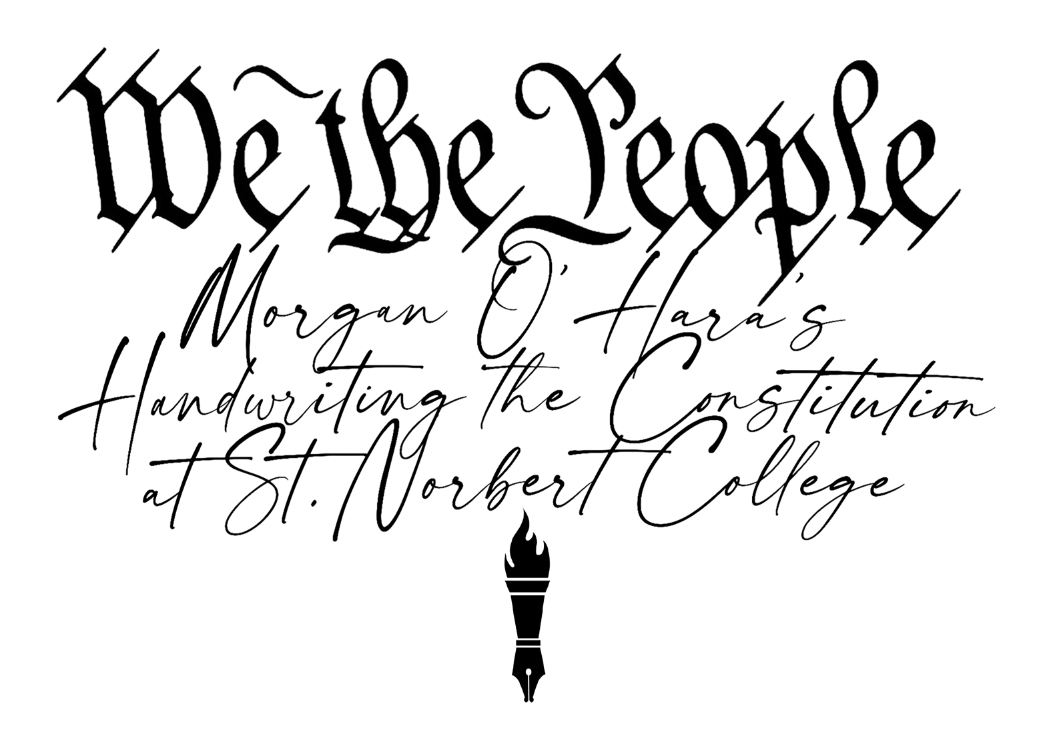
Handwriting the Constitution
Handwriting the Constitution is a social art project begun in 2017 by artist Morgan O’Hara. The project invites people from all walks of life to gather in public spaces to handwrite the United States Constitution or other documents created to protect human rights and freedoms.
Developed as a form of concentrated writing and civic reflection, the project encourages participants to slow down and engage deeply with foundational texts. Through hand-copying, participants often discover new meanings in familiar documents, gaining a deeper understanding of the rights and responsibilities embedded in democratic society.
The exhibition arrives at a particularly meaningful moment as the United States marks its Semiquincentennial year, the 250th anniversary of the nation’s founding. Visitors are invited to engage directly with the Constitution and reflect on its continuing role in shaping the promises, challenges, and aspirations of American democracy.
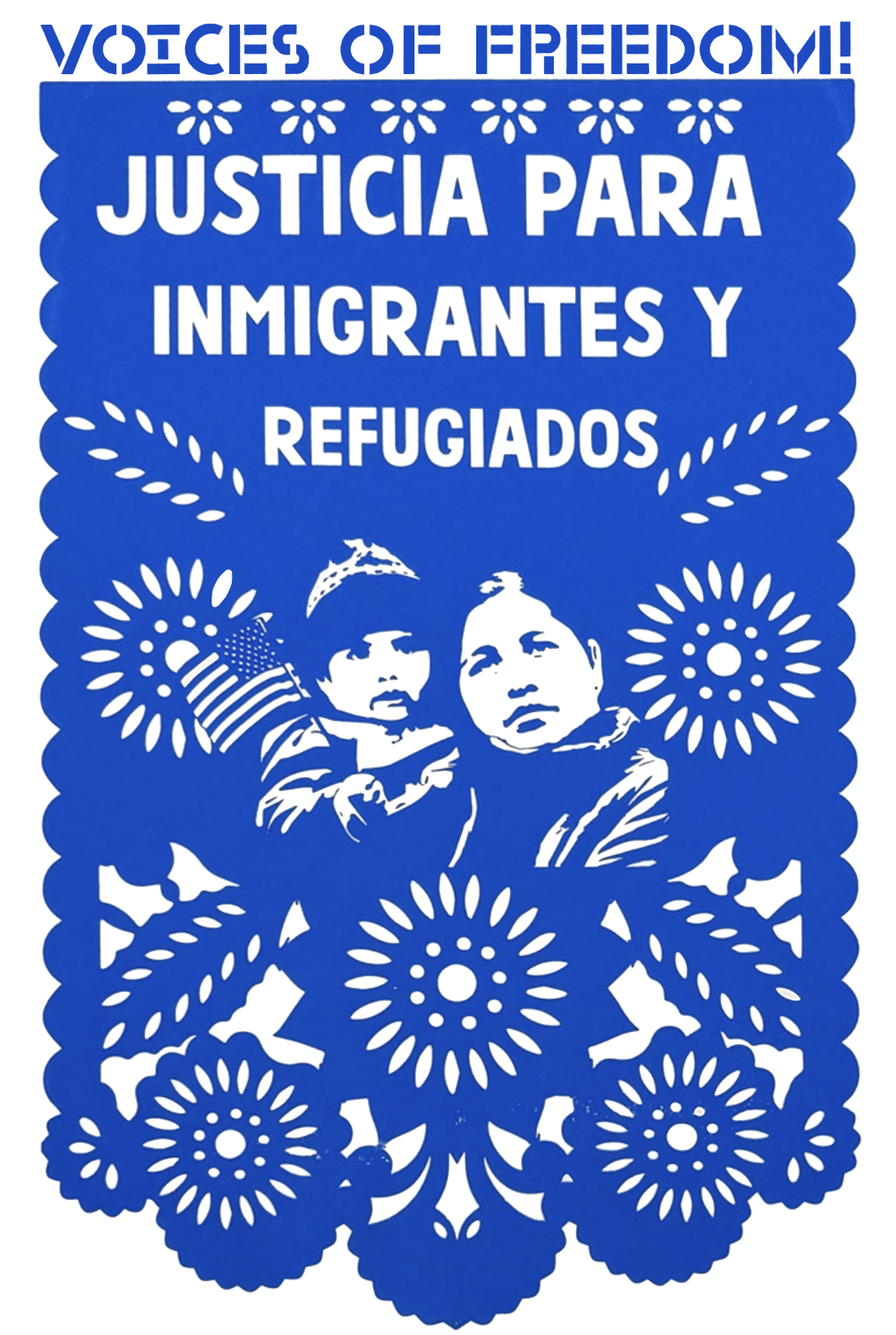
Voices of Freedom brings together works from three important portfolios: Carving Out Rights, Voices From Outside, and Community Defense: Voces de los Artistas. Through printmaking and graphic art, the exhibition examines issues of human rights, incarceration, immigration, and community defense. The exhibition includes work by artists responding to the Universal Declaration of Human Rights, challenging the prison-industrial complex, and working alongside immigrant rights movements to support communities impacted by detention, deportation, and family separation.
Collectively, these works demonstrate how art can serve as a form of civic participation and public education, and highlight how artists contribute to broader struggles for justice and human dignity while creating visual languages that inform, mobilize, and connect communities.
Just
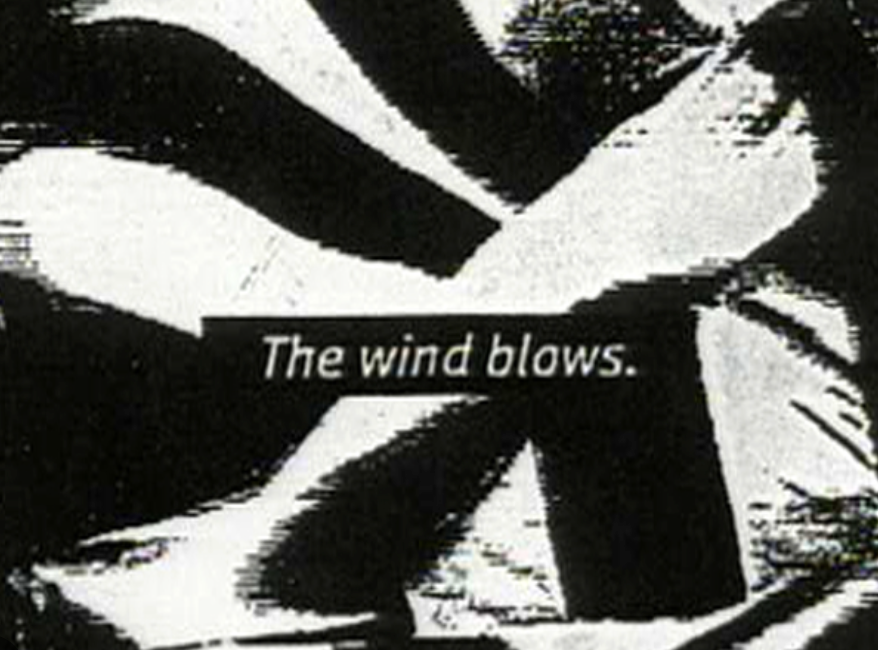
Also on view is Just (2002) by Korean artist Joon Soo Ha. Through the progressive degradation and transformation of image and sound, the work reconsiders one of the most recognizable symbols in American culture: the flag.
Repeatedly reproduced through digital and analog processes, including video, photocopying, printing, scanning, and re-rendering, the image gradually shifts away from its familiar form. In doing so, Just asks viewers to consider how symbols acquire meaning, how context shapes interpretation, and how cultural narratives evolve over time. Rather than presenting a fixed statement, the work creates space for reflection on the instability of images, the construction of meaning, and the ways visual culture influences public understanding.
Exhibition Dates & Public Programs
Taken together, these exhibitions demonstrate the many ways art can function as a form of public scholarship and civic engagement. Whether through the voices of incarcerated artists, the contemplative act of handwriting the Constitution, or the reexamination of national symbols, each exhibition invites visitors to think critically about democracy, human rights, justice, and the role of culture in public life. The St. Norbert College Art Department invites students, faculty, staff, and community members to engage with these exhibitions and the important conversations they can inspire.
Throughout the semester, a variety of public programs will accompany the exhibitions, including artist lectures, curator talks, gallery discussions, research presentations, and participatory engagement opportunities. Featured events include a campus visit by artist Morgan O’Hara, curator programs related to Art Against the Odds, and public Handwriting the Constitution sessions.
These exhibitions will open on August 24, 2026, and a public reception celebrating all four exhibitions will be held on September 10 from 6:00–7:30 p.m. in the Bush Art Center Galleries.
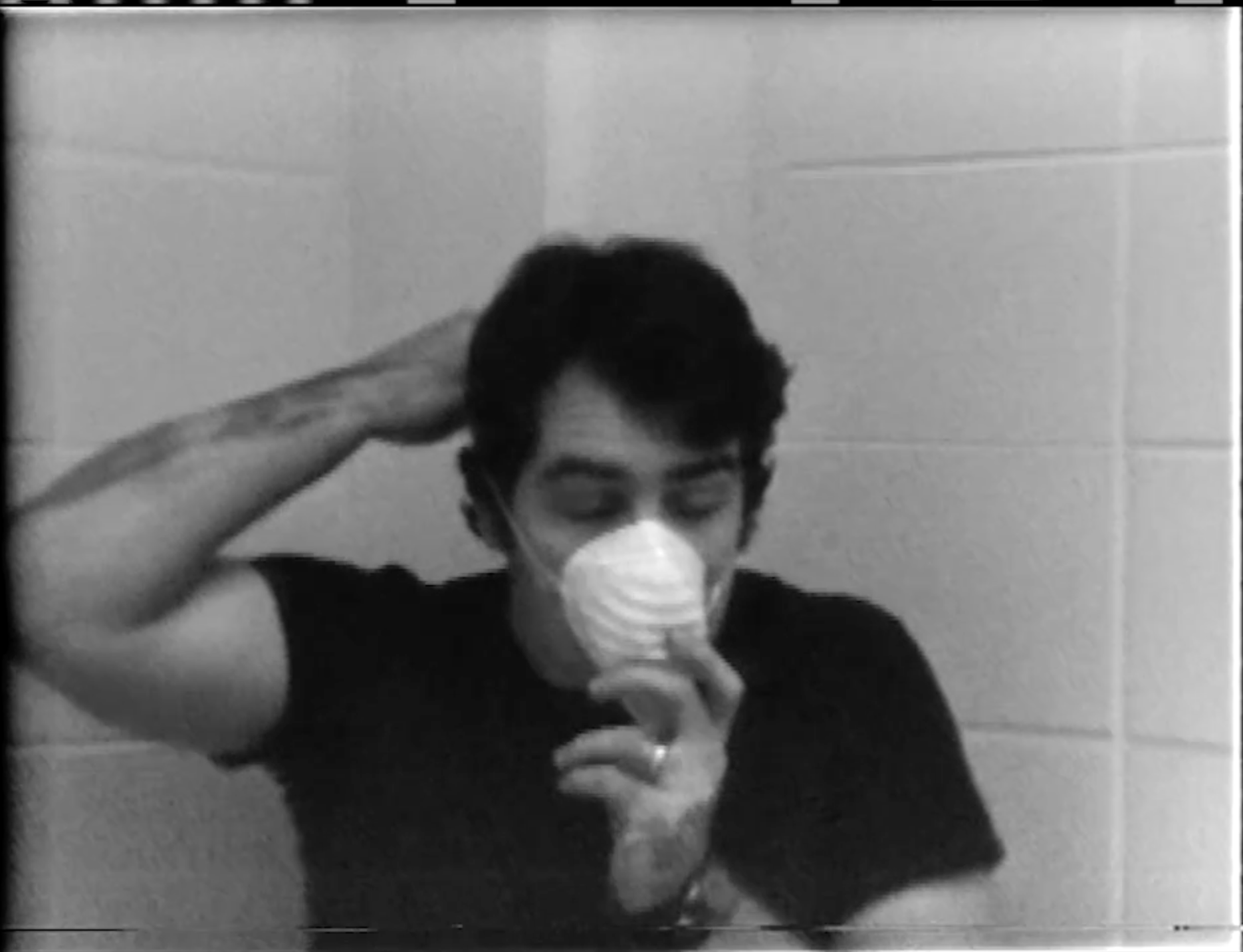
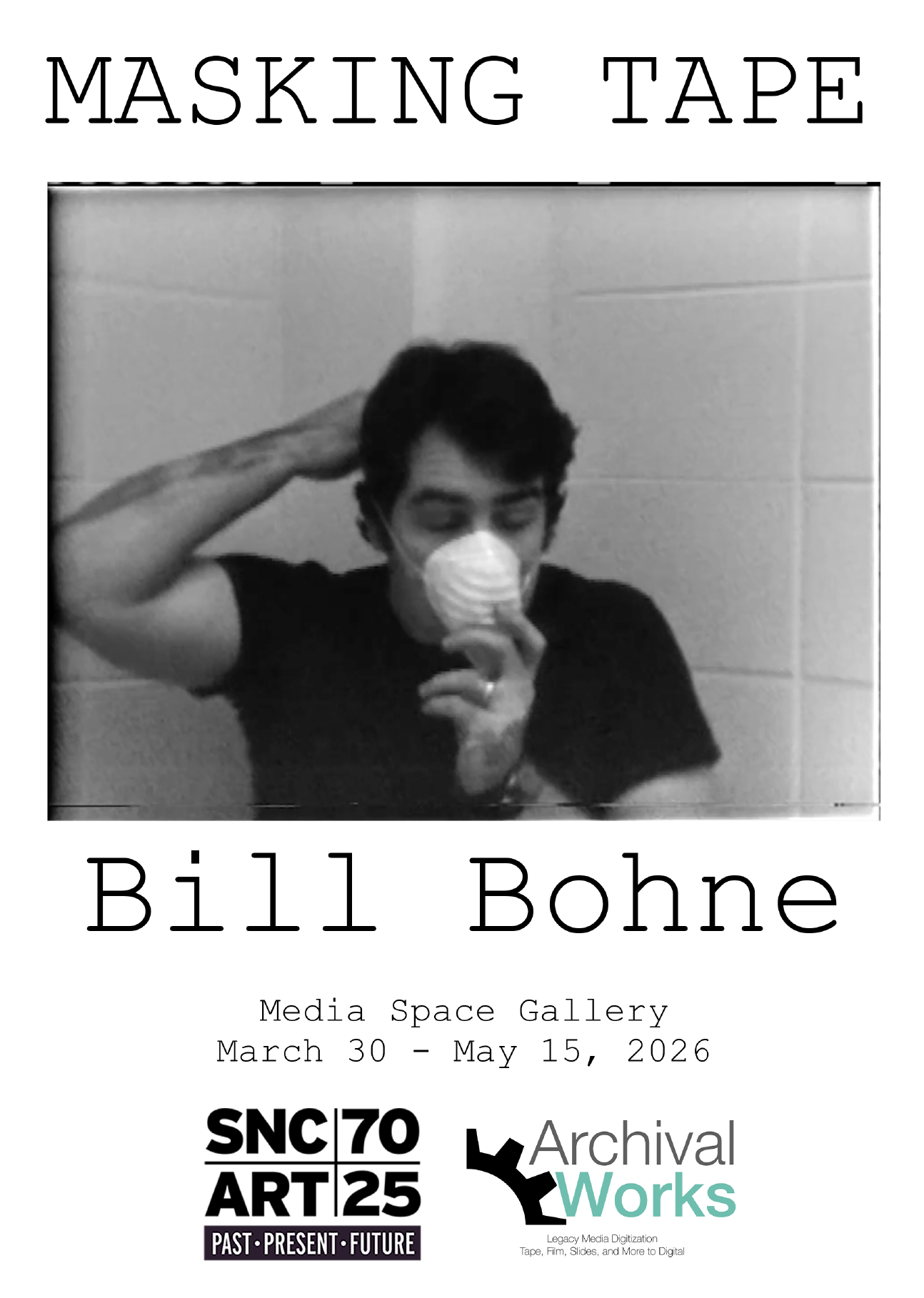
Bill Bohne’ Masking Tape (Early 1970s, Date Unknown) Single Channel Video transferred from ¾” UMATIC Tape B/W, Silent, 11:50
Bill Bohne’s video Masking Tape was created in the vein of early conceptual video art, specifically within the mode often described as “performance for camera.” Emerging in the late 1960s alongside the growing accessibility of portable video technologies, this approach was adopted by many artists exploring the possibilities of this experimental medium. These artists used the camera as the primary site of the work itself. Typically employing fixed framing, minimal editing, and durational actions. Such works foreground the body, repetition, and constraint while stripping away narrative and spectacle in favor of conceptual procedure.
Masking Tape adheres closely to these conceptual strategies. The camera remains static, focused on a head-and-shoulders composition as Bohne methodically places disposable dust masks over his face, one after another, throughout the tape. The action is simple, repetitive, and task-based, aligning the work with conceptual art’s emphasis on systems and instructions. At the same time, the accumulating masks gradually become sculpturally absurd and begin to impede the mask’s function, introducing a subtle tension between safety and suffocation.
Originally recorded on 3/4″ U-MATIC tape, the video was rediscovered in a storage area of the Bush Art Center and later transferred to digital format by Archival Works in St. Paul, Minnesota. This material history reinforces the work’s origin in an early moment of video experimentation, when artists worked with emerging, often fragile recording technologies that have since required preservation to prevent deterioration.
Viewed today, Masking Tape accrues new layers of meaning. The act of placing mask upon mask, once read primarily through the lens of conceptual procedure or performance endurance, now inevitably recalls the lived experience of the recent COVID-19 pandemic. What may have originally functioned as an abstract or absurd gesture takes on renewed resonance as an image of protection, anxiety, and the social politics of masking. The work’s repetitive accumulation mirrors the psychological weight of prolonged crisis. In this way, Bohne’s video not only participates in the historical discourse of early video art but also demonstrates how such works can be reactivated by contemporary conditions, generating meanings beyond their original intention and context.
– Brandon Bauer, Associate Professor of Art (2026)
Join us tonight, 6:00–7:30 PM at the Bush Art Center for an evening celebrating 70 years of art at St. Norbert College.
Experience four exhibitions: the Senior Capstone Exhibition in the Baer Gallery, new work by Donald P. Taylor in the Godschalx Gallery, Past Present Future featuring faculty across generations in the Permanent Collection Gallery, and Masking Tape, a rediscovered early video work by Bill Bohne in the Media Space Gallery.
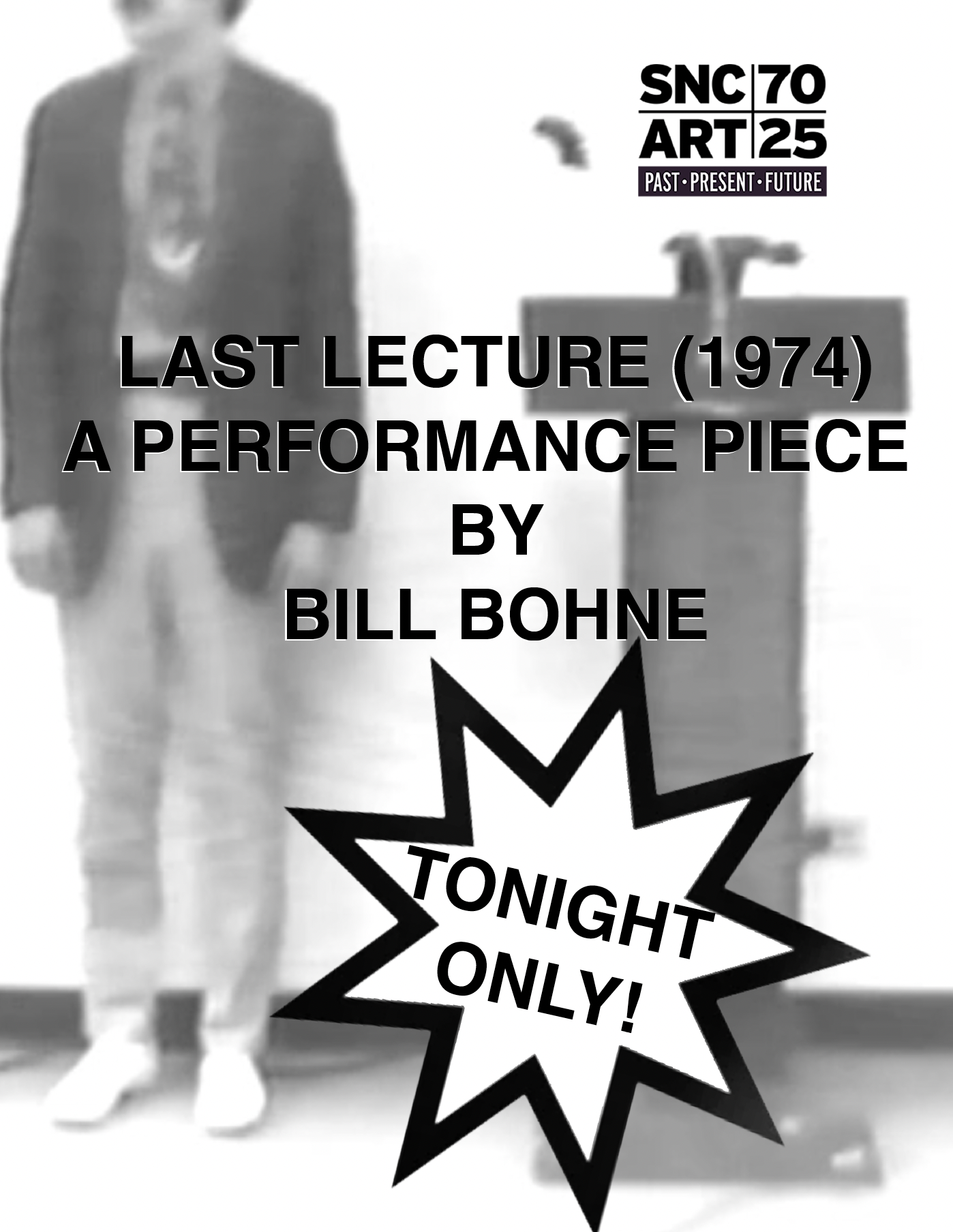
The evening also includes a special screening of Bill Bohne’s The Last Lecture in BAC 130!
Bill Bohne – Last Lecture: A Performance Piece (1974) B/W, sound, 31:11, VHS transfer to digital video (original video source unknown)
Bill Bohne’s Last Lecture: A Performance Piece (1974) is a work in the vein of early conceptual video art, emphasizing duration, repetition, and the body. This approach frames performance as a procedural and conceptual act rather than a theatrical event.
The video begins with humorous meditations on the notion of the “last,” moving between popular culture and high art while foregrounding the lecture as a constructed performance. Language becomes both subject and material through repetition and self-reflexive commentary. Bohne states, “I don’t want to be there for my last lecture,” and goes on to say, “You’ll notice when you look around the room this evening that I am not there, only in a mediumistic manner.” These statements destabilize presence and authorship, aligning the work with conceptual strategies that privilege idea over object.
Formally, the video adheres to and disrupts the conventions of performance for the camera. Bohne’s face is never fully visible, either cropped out or turned away, reinforcing the sense of absence. Repetition structures both language and movement, while rudimentary analog editing reflects the technological conditions of early video.
Described by Bohne as a “death avoidance fake-out,” the work culminates in his promise to give the lecture the “run-around.” For the remainder of the tape, he circles the camera continuously. After briefly attempting to follow him, the camera returns to a fixed position, allowing him to pass through the frame at regular intervals, foregrounding a static viewpoint and durational action central to early conceptual video practice. The soundtrack layers repeated phrases of “this is my last lecture,” which Bohne describes as an incantation. This accumulation transforms language into a rhythmic, quasi-ritualistic structure, collapsing meaning into sound and duration. In this way, Last Lecture exemplifies how early conceptual video reduces performance to procedural constraints through which presence, authorship, and temporality are tested with both rigor and humor.
Your gift helps fund student exhibitions, visiting artists, internships, and transformative experiences that bring learning to life.
You can donate at this link, with options to directly support students through supplies and travel funding, or to support our visiting artist program and the professional opportunities it brings to campus.
Every contribution, big or small, makes a real impact on our students, our program, and art and culture in our region.
The Bush Art Center Galleries are pleased to present a new slate of spring exhibitions celebrating the past, present, and future of the St. Norbert College Art Department.
This year marks a significant milestone: the 70th anniversary of the Art department and the 25th anniversary of the Bush Art Center as our department home!
The Art program was established in 1956 to bring art education to the campus community. Founded by Professor Daniel F. Dickhut, the College’s first full-time art faculty member and notably its first lay faculty member. The Art department played a pivotal role in shaping the institution’s evolution. In many ways, the Art department helped usher in a more expansive, interdisciplinary academic environment at St. Norbert College.
The exhibitions on view reflect this legacy, featuring selections from the permanent collection, new work by past and present faculty, and the Senior Capstone Exhibition, which highlights the achievements of graduating seniors as they prepare to carry their creative practices beyond the College and into the broader world.
Exhibitions Include:
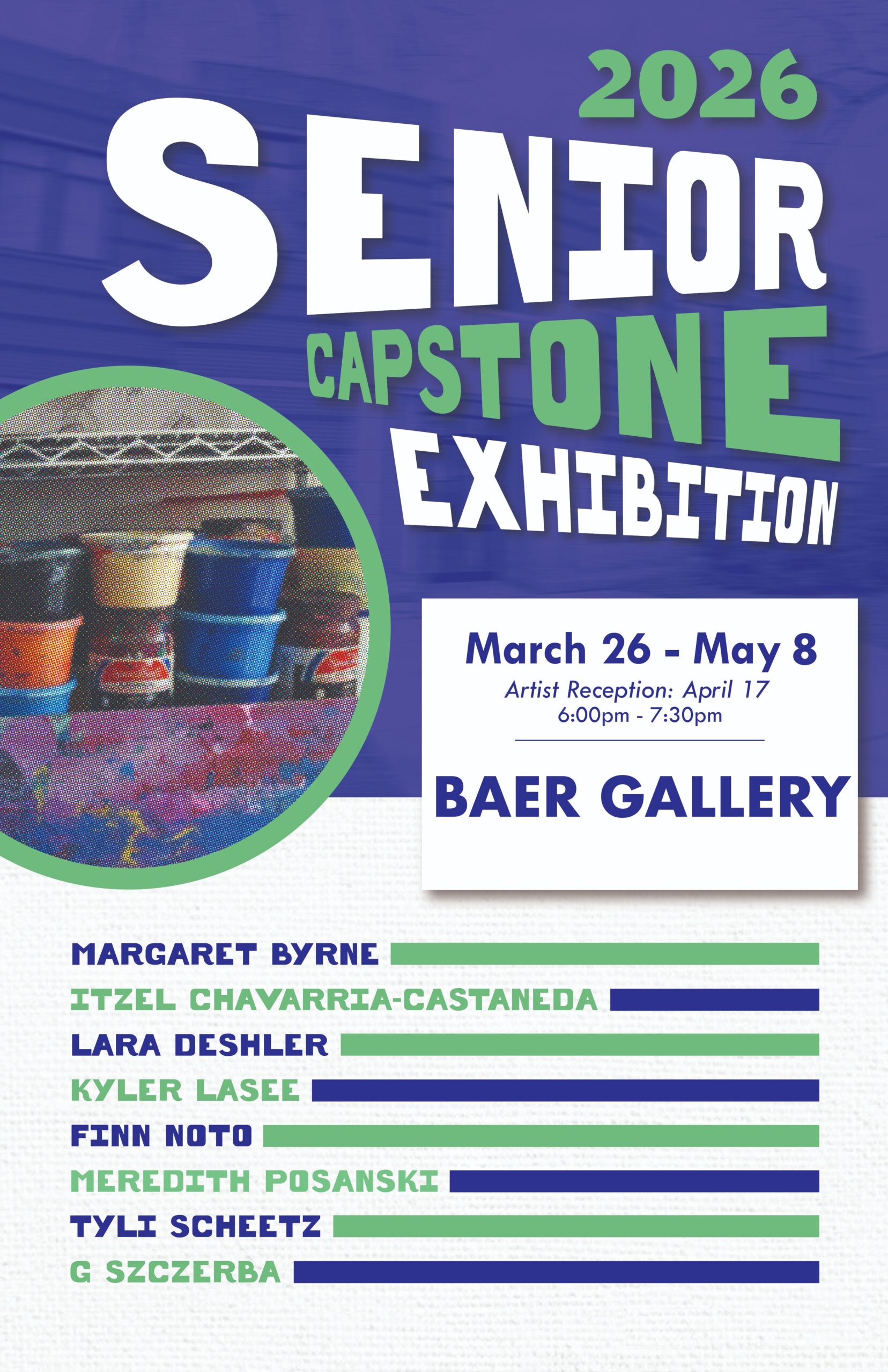
2026 Senior Capstone Exhibition (Baer Gallery) Featuring work by Margaret Byrne, Itzel Chavarria-Castaneda, Lara Deshler, Kyler Lasee, Finn Noto, Meredith Posanski, Tyli Scheetz, and G. Szczerba.
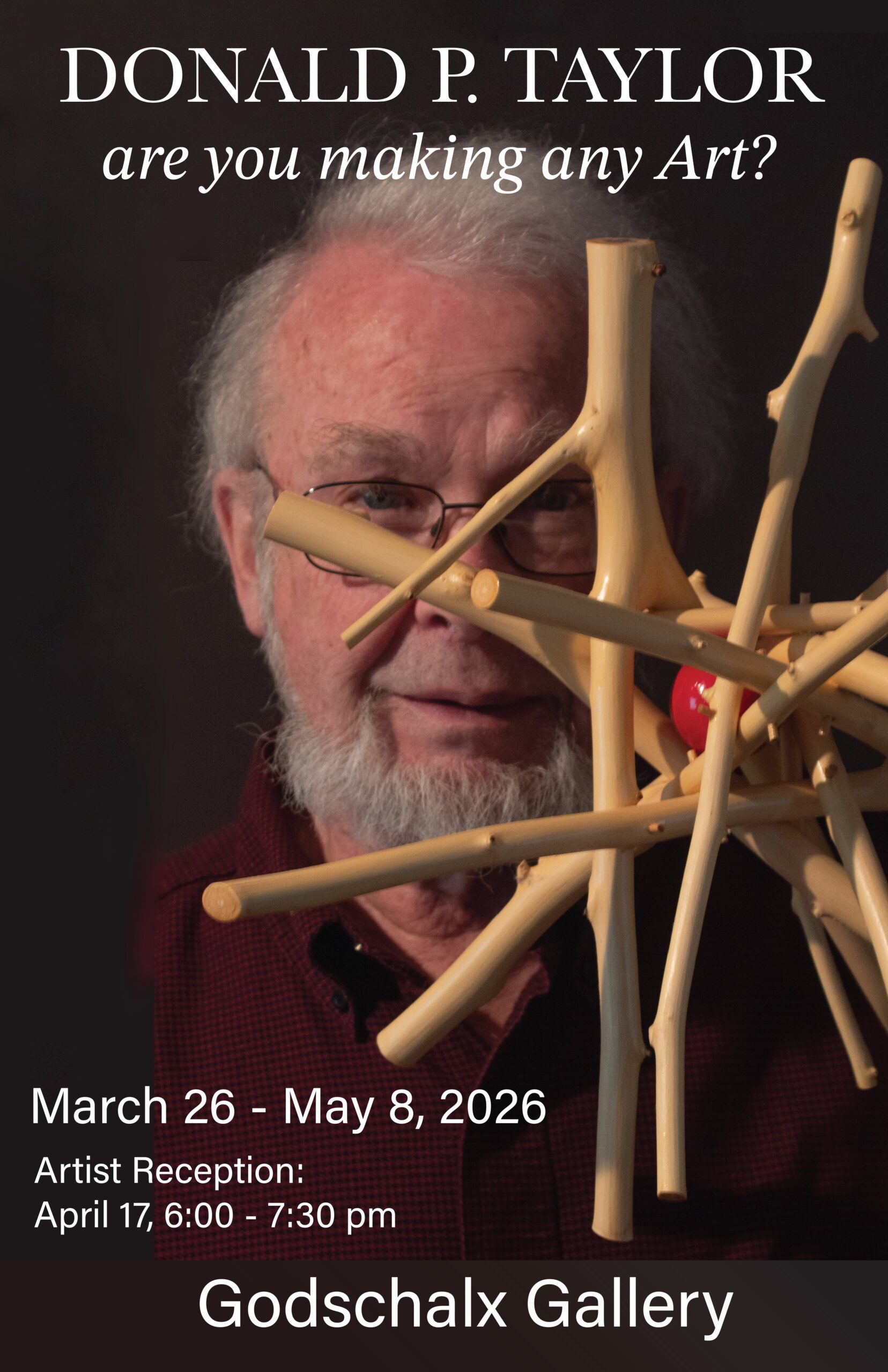
Donald P. Taylor: are you making any Art? (Godschalx Gallery) Presenting new work by emeritus faculty member and former gallery director Donald P. Taylor.
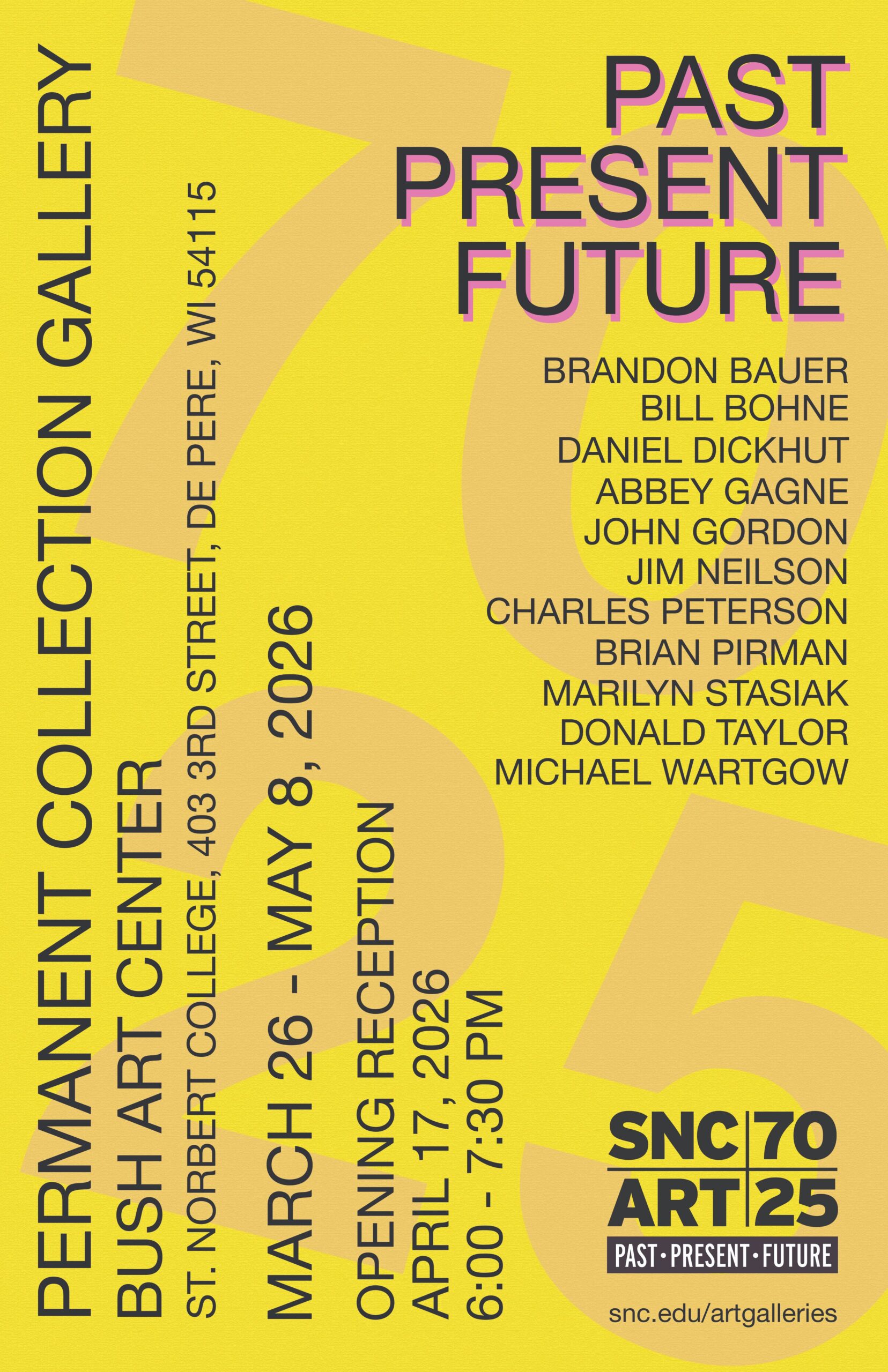
Past Present Future (Permanent Collection Gallery) Showcasing work by current and former faculty, including Brandon Bauer, Bill Bohne, Daniel Dickhut, Abbey Gagne, John Gordon, Jim Neilson, Charles Peterson, Brian Pirman, Marilyn Stasiak, Donald Taylor, and Michael Wartgow.
Masking Tape by Bill Bohne (Media Space Gallery) A work of early video art recently rediscovered and digitally archived for exhibition.
The opening reception will take place on April 17, 2026, from 6:00–7:30 p.m. and will include a special presentation of Bill Bohne’s video performance piece, The Last Lecture, in the Bush Art Center Lecture Hall (BAC 130).
Please join us in celebrating 70 years of art at St. Norbert College and the vibrant community of artists, educators, and students who continue to shape its future.
The annual juried exhibition of work by current St. Norbert College students is on display! All current students were able to submit work made during their time in college.
This year’s strong show features six award-winning artists, selected by juror Laura Schley, the Public Arts Coordinator for the City of Green Bay. Laura graduated from UWGB with a double major in Art and Arts Management with emphases in Painting, Textiles and Gallery and Museum Practices. Her personal artistic practice includes painting murals, sewing and mending clothes, and experimenting with fibers and natural dyes.
Congratulations to the following award winners:
First Place: Maddie Smith
Second Place: Catherine Nelson
Third Place: Gia Minneci
Honorable Mentions:
Emma Fry
Tylie
Samuel Satterlie
Honorable Mentions
Emma Fry, Smile. Illustration, print on paper.
Samuel Satterlie, Ghoul. Monotype print on paper
Tylie Scheetz, Orange You Glad It’s Tea Time? Clay
Tylie Scheetz, Orange You Glad It’s Tea Time? Clay
Third Place
Gia Minneci, Cavities. Monotype print on paper
Gia Minneci, Cavities. Monotype print on paper
Second Place
Catherine Nelson, Room to Grow. Relief print on paper
Catherine Nelson, Room to Grow. Relief print on paper
First Place
Maddie Smith, Behind the Scenes of An American Farmer. Photograph on paper.
Maddie Smith, Behind the Scenes of An American Farmer. Photograph on paper.
The exhibition will be on display from November 6-December 1, and the reception was on November 9th from 5-6:30 p.m.
Congratulations to all!
Poster, marketing materials, and awards cards designed by Sydney Suchy.
Storied Lives is an exhibition of remarkable photographs, featuring portraits by David Graham from his book Land of the Free and selections from Death|s|trip by Terri Warpinski.
Terri Warpinski, Anton Walzer, October 8, 1962
Accompanying Warpinski’s photographs are laser-cut text panels, which overlay historical maps. According to Warpinski’s artist statement,
Death[s]trip is a story of human mortality written on the landscape. In looking at present day Berlin through the filter of history, these works combine contemporary photographs and text with archival elements to reveal some of the consequences of enforced political borders. From 1961-1989, 140 individuals died in failed attempts to flee over the Berlin Wall from Soviet occupied East Germany to freedom in West Berlin. Focusing on these victims, Death|s|trip probes the contingent properties of meaning, memory, and reflection in relation to both the landscape and the photographic image.
Each site was photographed on the date that coincides with the anniversary of the victim’s death, in the specific location where the event took place.
David Graham describes his work as follows:
Land of the Free is photographer David Graham’s tribute to the American people in all their idiosyncratic splendor. A tireless traveler and a natural-born visual storyteller, Graham has photographed ordinary folks in their homes, at work, and at play across the nation to assemble a composite picture of America. Graham’s colorful portraits showcase the personalities who give America its character.
David Graham, Todd Gerding as a Hessian Granadier, Richboro, PA
Storied Lives is on display now in the Baer Gallery until September 21. Graham and Warpinski are the directors and curators of NewARTSpace, a local gallery and studio just across the bridge in downtown De Pere, Wisconsin.
The annual juried exhibition of work by current St. Norbert College students is on display! The juried show is open to all current students. This year’s jurors are David Graham and Terri Warpinski, professional artists and curators of NEWArtSpace, a gallery and studio space in downtown De Pere.
This year’s award winners with the jurors. From left to right: David Graham, Sydney Suchy, Logan Elkin, Catherine Nelson, Emma Fry, Emily Friday, Jackson Venski, Terri Warpinski.
This year’s winners were selected based on the quality of the entire body of work featured in the show, rather than a specific piece. Congratulations to all!