This past Thursday, November 15 marked the 2018-2019 Annual Juried Student Art Exhibition Awards Reception. Students, both art majors and non-majors, put out a strong showing for this year’s exhibition, creating a monumental task for awards judge Dr. Carol Bruess.
Dr. Bruess is an alumna of the St. Norbert College Art Program and received her M.A. and Ph.D from Ohio University’s School of Interpersonal Communication. She is the author of numerous books spanning topics of family relationships, marital relationships, and communication in the digital age. Dr. Bruess remains an active supporter of the arts and was a jovial and inspirational presence for the students at last week’s event.
The awards shook out as follows:
Honorable Mentions:
Morgan Pennings, A Day in the Life, Short film
Lukas Thornton, Dysphoric, Watercolor on paper
Emerson Bartch, Flesh Eater, Wax, soil and wood
Third Place:
Katie Hopkins, Communio, Screen print on paper
Second Place:
Elizabeth Hein, Reliance, Screen print on paper
First Place:
Devin Morrisroe, Eavesdropping, Charcoal on paper
To see even more of the artwork in this exhibition, come visit the gallery when its regular hours resume after Thanksgiving Break: MTWF from 9am-3pm, and Th from 9am-7pm. The show is up until December 7.
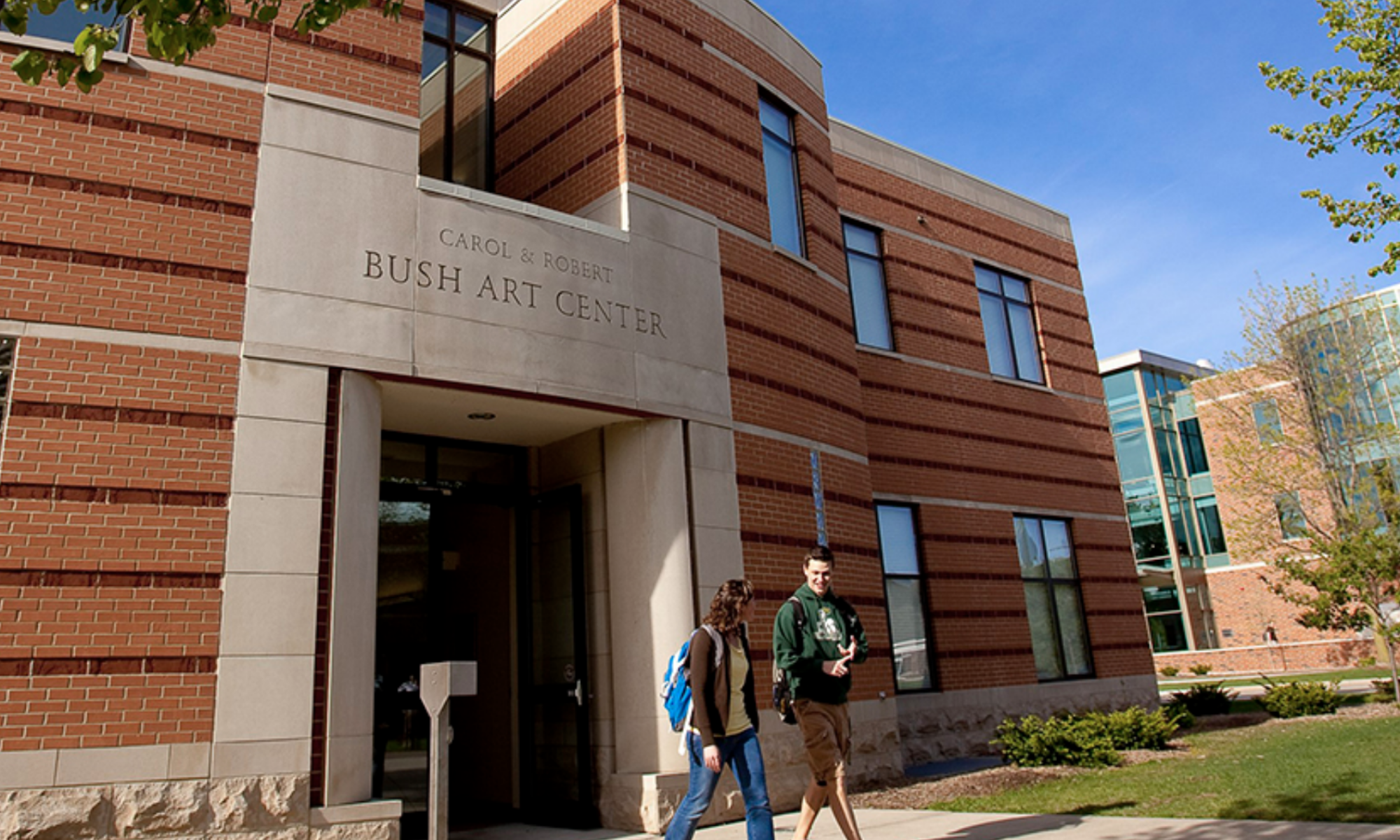
The Needle has Moved: A Retrospective Exhibition Celebrating the Fifty-Year Career of Tattoo Artist Rick Harnowski is the most recent installment at the Bush Art Center Galleries of exhibitions that have generated physically palpable and widespread excitement across the campus community as well as the greater Green Bay community.
Spreading across all three gallery spaces at the BAC, The Needle Has Moved is a visual, auditory, and tactile experience that refuses to be contained by any single medium. The show is about tattoo artist Rick Harnowski and while the walls are plastered with photographs of his tattoo work, it is so much more than that. The show a wunderkammer of memorabilia from Harnowski’s life. With examples of his painting, drawing, graphic design, photos from his childhood, news clippings, an actual motorcycle, and reflections on his immigration from Poland at a young age, this show is a study of Rick Harnowski himself.
In hopes of diving behind the scenes of The Needle Has Moved, I was lucky enough to be able to sit down with the curators of the show themselves—Brian Pirman and James Neilson—and discuss the workings of the show, and find out just what makes this show tick.
From left to right: Brian Pirman, Rick Harnowski, and James Neilson
Katie Hopkins: Curating a retrospective exhibition for Green Bay tattoo artist Rick Harnowski is no small feat when considering his accomplishments, but for those who don’t know, what has made Harnowski so monumental in the tattoo scene that raises him above and beyond other artists?
Fr. James Neilson: Well the staying power, having a career of fifty years has its merits of course, but Rick was so instrumental in recognizing the need for reform in the industry. He appealed to government agencies and the state itself to have higher standards of excellence for the safety of the clients as well as for the practitioners of this artform.
Brian Pirman: Another part of the equation [in curating this exhibition] is his son Josh, who Rick shares the studio with. Basically Rick has a chair, and just down the way Josh has a chair. Josh went here to St. Norbert, studied art, graduated in 2007, and he’s become part of the equation over at Tattoos by Rick. Knowing Josh, is how we got to know his dad. We actually took a couple of Art Thursday* field trips out there and that started the beginning of this relationship. But to Jim’s point, you know, working with local government to make sure that it’s safe, he won’t tattoo anyone that’s underage, and there are certain tattoos that he refuses to do. He has these ethics that apply to hygiene as well as symbols and concepts.
*Art Thursday is educational programming put on for the Art majors and minors here at SNC.
KH: Looking at Harnowski’s work, the artistry, care, and technique behind each piece, it’s not hard to see why you’ve decided to dedicate an entire show to his career, but tattoos—no matter the quality—are often met with social prejudice based on appearance and assumed personality traits.
What do you hope the response to this show will be based on the marriage between the subject matter and the formal gallery setting?
JN: I hope there’s a greater consideration for the history of this artform by having it here. I’m actually offering a tutorial to twenty honors students in conjunction with this, so we actually have an embedded educational experience. After twenty five years in the art department, I’ve noticed a shift among the students who have ink. A greater number of students today have ink than they did fifteen years ago, so we want to of course recognize and acknowledge this. We want to think deeply together about what’s going on here. I think the personal narrative of tattooing is always fascinating and the ink wants to speak. These images want to speak and so this is about a dialogue, this is about a huge conversation across campus, within the local community and this is a world phenomenon as well. It’s hardly isolated right here, but we have one of our own who has dedicated his life and has passed his skills onto the next generation and that’s worthy of celebrating.
BP: Speaking more to this sea change within the last ten to fifteen years, there’s been a shift when it comes to people acknowledging, appreciating, and getting tattoos. It used to be the biker who would get the Harley logo, or the sailor who would get the anchor, and its really evolved into something much more. Tattooing has gone from pieces of spot art or line art, like an anchor or a ladybug, something that’s high contrast, to highly illustrative pieces and Rick and Josh both have embraced that. And in some regards I think that they’re the best there is in terms of the quality of the work they do. I think the main thing is that there’s that sea change. Now as far as what’s caused it, personally I think it’s professional athletes. Dennis Rodman, twenty years ago, had tattoos all over his body and many people thought he was strange or a freak, but more and more athletes started getting tattoos and I think it eventually meshed itself into the culture of who we are.
I had the pleasure of meeting Rick when the exhibition was getting its dress rehearsal check, and he was nice enough to let me take his photograph.
KH: Since I have two art professors here to speak to my next query, I want to ask about tattoos from an art history perspective. Tattooing has been around for centuries, and anything that’s survived that long, albeit undergoing transformations, has to have inherent value. What is it about marking our bodies that speaks to us on such a basic level that it has allowed this art form to endure for so long?
BP: I’ll let Jim answer that one—how long have tattoos been going on?
JN: Oh, some say prehistoric times. We can find the evidence with mummified figures. This is ancient. This is a way we understand who we are. It’s as much about memory as it is communicating correctly and mysteriously with others. It’s all part of the whole notion of how we reveal ourselves. Tattoos can be rewards, our own specialized memories, or so many other things. We reveal ourselves through mystery, memory and symbols.
KH: Besides simply coming and enjoying the exhibition as a viewer, are there other opportunities for community members to get involved with The Needle Has Moved?
JN: We’re going to be having live tattooing in here so people can observe how this looks and sounds, and see the process of the artist himself at work. We’ll be teaching the students how to use the tattoo guns, under the supervision of Josh Harnowski, a tattoo artist himself. They will be working on prosthetic skin, learning the basics as Josh learned from his father, which I think he learned on grapefruits maybe.
*Interested parties can keep an eye out for information on these special events through the BAC Galleries Blog, the Gallery website, the SNC Art Facebook and Instagram pages, and SNC News.
KH: Any parting thoughts or tidbits about the show you would like to pass along to the readers?
JN: There is no typical type of tattoo, there’s a huge variety and we hope that the show reveals this. Tattooing has evolved—what was popular in the 50’s or even the 90’s is no longer popular now. It’s a response to the sign of the times and I’m very very curious with new technologies and new ways of thinking to see how this will be understood, received, and inked into the future.
BP: I think the biggest part of this is just to acknowledge Rick Harnowski and his involvement in the community in terms of making tattoos a respected art that follows good hygiene. Rick puts on an international tattoo show every year, but he’s kind of a quiet guy and not much of a self promoter, so I think it takes others like Jim and I to basically get him out front and center to the local population. And from what I understand there’s going to be people visiting this show and reception from not only the United States, but from France and Germany as well. So the reception, I think, is going to be a big to-do and it’s all about paying respect to Rick.
End.
Rick interacting with the timeline of his life located in the Permanent Collection Gallery.
To see this exhibition for yourself come stop by during the gallery’s regular hours, MTWF, 9am-3pm, and Th 9am-7pm. Keep an eye out on all SNC Art media avenues for information on extra events in conjunction with this show and make sure to attend the gallery reception on Thursday, October 11 from 5-7pm.
Chicago-based painter and commercial artist Shelby Rodeffer, a visiting artist on campus, is painting a mural in the north entryway of the Bush Art Center with the assistance of SNC Art Students!
Stop by to see the work or lend a hand. An exhibition of Rodeffer’s art will be in the Bush Art Center later this semester.
This week I had the opportunity to sit down with artist April Beiswenger and talk to her about her exhibition currently featured in the Godschalx Gallery, April Beiswenger: The Making and Giving Project.
On sabbatical from her regular position as a professor of Theatre Studies here at SNC, Beiswenger spends much of her time in the gallery doing just what she asks visitors to do: making and giving. The exhibition offers many opportunities for visitors to create and engage including: bracelet making, typing letters on a typewriter, coloring postcards, asking the sage advice of the Bird Oracle, and much more.
The following interview explores the philosophy and mission behind Beiswenger’s interactive exhibition, an exhibition that allows viewers—or rather makers—to revel in the simple and inherent satisfaction of creation and the joy that comes from giving a creation away. The overarching message she wants you to get? Don’t be scared of making. Just do it, move on, and then do it again.
Katie Hopkins: Tell us a little bit about how the Making and Giving Project originated.
April Beiswenger: The idea behind the Making and Giving Project is that there is an art to making, and that’s what we learn as students and as adults. As we become artists we learn the “making,” but sometimes we miss the “giving” part. And so, it happened at my gallery show last year, [April Beiswenger: ‘I like this place, and willingly could waste my time in it.”] whenever I was in the gallery and I was working on that topographical map—gluing the beads down to that—people would come by and talk to me about it, so it sort of sprung from that idea of I’m gonna make things and people are gonna watch me make things.
What am I gonna do with the stuff I make? Well, I’m gonna give it away. Because we get all these skills that we’re not necessarily gonna use, you know, like beading and knitting and crocheting and all of this stuff that it becomes like an impassioned hobby and not necessarily lucrative. But we can’t not make, so what about just giving it away? So that’s kind of where it sprung from, like what if I just gave stuff away?
KH: Do you think that the location of your exhibition here at the SNC Galleries helps with that “giving” aspect of your mission?
AB: I think so. There’s a giving-ness to the St. Norbert College community that has been quite apparent ever since I got here, that idea of radical hospitality, that you don’t necessarily see in other [institutions]. I went to a Catholic school for undergrad, went to a Catholic school for grad school, I worked in another Catholic school when I first started teaching, and now here. There’s always an element of giving when working for Catholics which is interesting, but there’s this element of giving that they had, but they didn’t have ingrained in their mission, this idea of radical hospitality and Communio, which is one of the reasons I love working here so much. [Here] they’re just open hearted and giving and it kinda works really nice, and watching people engage with the elements in this room makes me really happy.
KH: Is there a certain element or activity that visitors seem to like the best so far?
AB: That typewriter! So I bought this typewriter a bunch of years ago whenever we were gonna have a Sandbox over in the library—this maker space—and it never really ended up coming in. So [the typewriter] moved with me when I moved houses and I tripped over it in my workshop at home and I thought “let’s use the typewriter,” why not? There’s an activity to typing that you don’t get with a computer or texting. There is a physical, mechanical-ness that you get using a typewriter that you don’t get anywhere else that’s really visceral. My mom was a secretary for ages and ages, but when my sister and I were kids, she had this typewriter that she was like, please shut up, use this, and so Gina and I, my next younger sister, we would type for ages with this thing. And then my youngest sister Lisa, and Adam, my brother, we all had an experience with this typewriter. And the typewriter goes with the other mechanical objects in the gallery like the Rigid Heddle Loom and the Inkle Loom and the crocheting, that are mechanical production, hand production that is just so wonderful. There’s a pleasure to it, a pleasure to using your hands.
The typewriting station.
KH: Do you think that the students in particular are drawn to the typewriter because they are so used to just texting on their phones?
AB: I absolutely think so. I think it’s a novelty. And it’s something that is, unlike the looms, where you have to have a little bit of skill to use the looms, the typewriter is just like your laptop and you just clunk clunk clunk clunk clunk and you’re on your way. Hopefully I can do another Making and Giving event, like last week I did silk dying and this week is the Yarn-In*, and so I have two and a half weeks left, and in that time I’ll do a “hey come touch a loom, you’ve never touched one before, come touch a loom!” And people will probably not think anything of it now, but it’ll intrigue them and ten years down the road, twenty years down the road they’ll really enjoy that and say, hey, I’m gonna buy a floor loom and see what happens.
*The Yarn-In is Friday, September 14. It is an all-day event in the Godschalx Gallery. Come and go as you please with your own project, or learn the basics of crocheting from April.
KH: Where can people find out when the Making and Giving Events are happening?
AB: I put them on the SNC news and I send out a classified.
Silk Scarves dyed at the first Making and Giving Event.
KH: Do you have a favorite making station in here?
AB: The looms. I picked up weaving a couple years ago, and I did beading and it was alright. And then I got into this and started it when I started teaching the History of Clothing and Fashion. I don’t want to give the illusion when I teach this class that these clothes sprung fully formed from a machine. In history there’s actually people making this stuff. When you see Marie Antoinette over and over in these fabulous dresses, she has a woman who runs her dressmaking studio and had the ear of the queen and affected policy. It’s the idea of somebody who makes so well that they can affect policy change. And you know that happens all the time. And so it started there and then I did this great weaving workshop in May up at Sievers School of Fiber Arts in Washington Island. My mom and I went up and weaved pieces which was great because I got to spend time with my mom, and again it’s that mechanical making that is so, so satisfying.
KH: There’s a sense that you really want people to be more well-balanced and that making/mechanical production can help with that.
AB: I think so, I think so. The other one I like a lot, which is less active is the Bird Oracle and I kinda dig that. It’s just come and pull a card and get insight.
KH: I’ve asked the Bird Oracle a few questions and I’ve loved it every time.
AB: Excellent! I have the weirdest words in there. I went online and searched weird words and I got these lists and used them. I don’t know what they mean! I’ve forgotten what they mean. I have them written down in my notebook and every once in a while I have to go what did that word mean…oh yes, that’s what it was!
KH: I believe there’s magic in it, I’d like to think so.
AB: For sure. Especially because I have no clue what they mean.
KH: That’s the beauty of it! You can interpret it however you want.
AB: The magic of a dictionary.
A quilt of stamped denim squares. Take one down and take it home.
KH: Do you have any future plans to keep this project going?
AB: Yes. This has worked really well. Better that I thought it would. I think the idea of performative making is something I’m going to continue to explore. I do that in my classes. We make stuff together in my design classes and in our lab class for the show. We make together and it’s like connective tissue. It’s the old idea of the quilting bee. You sit around and make together. We used to call it the stitch and bitch. My aunts and family would get together and get into a costume shop and we would all just have our projects and we’d just sit around and complain or gossip. It’s really fun, but it’s kinda stereotypical that you would expect a costumer to know all the good gossip. Which is not true. Carpenters know all the good gossip. So yeah I really like this. I might figure out a way to take it out into Green Bay, maybe with the Boys and Girls club. Maybe with taking it into Art Garage and doing a mini residency. The only reason it works really well right now is because I’m on sabbatical. I was able to take a month out of my sabbatical and spend time in here. During the regular semester there’s no way.
KH: What’s nice is that the concept of making and giving can easily be taken out into the world by anyone. Because of that, this is one of the most approachable exhibitions we’ve had in the galleries especially with visitors being able to physically engage with the art.
AB: And that’s why my next couple [of exhibitions] will probably be very performative.
KH: Those are always a big hit.
AB: I hope so.
End.
Catch the Making and Giving exhibition in the Godschalx Gallery located in Bush Art Center until September 28, 2018. Keep an eye out for those pop-up Making and Giving events and be sure to visit the gallery on SNC day, September 22 for more special activities.
Welcome back, St. Norbert community and beyond, to another exciting year in the Bush Art Center Galleries.
To kickoff the new school year, the Baer Gallery is privileged to be hosting the Contemplation Through Illumination exhibit as part of St. Norbert College’s “A Year With The Saint John’s Bible.”
The centerpiece of Contemplation Through Illumination is the Gospel and Acts volume of one of the very limited Heritage Editions of the Saint John’s Bible, along with some various illuminations from other volumes of the same edition. Being that the original Saint John’s Bible, the first illumination of it’s size to be commissioned by a Benedictine monastery in more than 500 years, is safely housed at Saint John’s University, the Heritage Edition is the closest you can come to experiencing the beauty of the Saint John’s Bible at a traveling exhibit.
The Heritage Edition is “the only full-size, limited, and signed and numbered fine-art edition that will ever be produced,”¹ and is able to exude the brilliance of the original work as it was carefully created with Donald Jackson, the creator of the original document, at the helm as creative director.
Accompanying the Heritage Edition is a video exploring the creation of the Saint John’s Bible, as well as a collection of manuscript pages from the Saint Norbert College Art Collection that allow visitors to compare pages dating from the 13th to 17th centuries to the contemporary Saint John’s Bible.
The exhibit will run from August 27 until September 28 and will host a reception on September 11 from 4:30-6:30 p.m.
Concurrent Exhibitions
Alongside of Contemplation Through Illumination, the Bush Art Center is currently hosting two other exhibitions. See below for details:
April Beiswenger: The Making/Giving Project, Godschalx Gallery*
Selections from the SNC Art Collection, Permanent Collection Gallery
*Check back on the blog soon for an in depth look at this exhibition, including an interview with the artist herself.
Upcoming Events
Gallery reception, September 11, 4:30-6:30 p.m.
Lecture “From Inspiration to Illumination: An Introduction to The Saint John’s Bible,” September 11, 7 p.m. in Fort Howard Theatre (Lecturer Tim Ternes: Director of The Saint John’s Bible)
SNC Day, September 22, 10 a.m-4 p.m.
Footnotes
¹From the informational literature available at the gallery, provided at the courtesy of Saint John’s University and St. Norbert College.
Interested in what we are currently showing in our galleries, but couldn’t make it to the reception last Thursday? Read below to find out what is currently living in the Baer, Godschalx and Permanent Collection Galleries, and then come on down to see the work for yourself.
Lightforms: Heather McKenna, Maria Rendón, Paul Simmons, and Nicholas Szymanski
The show, Lightforms: Heather McKenna, Maria Rendón, Paul Simmons, and Nicholas Szymanski, is guest curated by Kate Mothes and resides in the Baer Gallery. In the statement provided at the exhibit, Mothes emphasizes the influence of the enigma of light on the works in the show, particularly the relationship between “light, form, and space.” The artists represented in this show hail from Brooklyn, NY, Los Angeles, CA, Brooklyn, NY, and Grand Rapids, MI respectively, bringing a wide variety of style and experience to St. Norbert’s campus.
Gold, God, Glory III (left), and Yellow Rising (right) by Maria Rendón.
Untitled (related but unrelated all the same, 1) (left), Untitled (related but unrelated all the same, 2) (middle),and Untitled (related but unrelated all the same, 3) (right) by Heather McKenna.
Works by Nicholas Szymanski (all untitled).
Daylight Savings (Green) (left), Daylight Savings (Pink and Green) (middle), Daylight Savings (Yellow, Yellow) (right), and Daylight Savings (Violet on Mint/Green) (far right) by Paul Simmons.
Rafael Francisco Salas: Ballads of the Middle
In his solo show in the Godschalx Gallery, Salas reflects on “American culture and identity,” and our “indignant desire for a dream continually just beyond reach,” as he so eloquently expresses in his artist’s statement. Using mixed media and a motif of musicians as witnesses to the “dispossessed and forgotten” Salas creates a show that is both comforting in its familiarity and nostalgia, yet unsettling in its demonstration of its intimate knowledge of the American public.
Musicians and a Patch of Dirt by Rafael Francisco Salas.
Preserving the Landscape
Preserving the Landscape is guest curated by one of SNC’s very own students, Kasey Pappas. The exhibition features four photographs by James Cagle, pulled from SNC’s own art collection. Check out this previously written blog post to find out more about the show and read an interview with Pappas herself about her experience curating her first show.
If you’ve visited the St. Norbert Art Galleries recently you may have noticed a humble, yet entrancing show tucked away in the Permanent Collection Gallery. This exhibition, Preserving the Landscape, features four photographs taken by former SNC art faculty member James Cagle, but is very special for one other reason as well: the show was curated by SNC sophomore Kasey Pappas.
Pappas curated Preserving the Landscape as a requirement of the Admissions Fellowship in the St. Norbert Art Galleries that she was offered her during freshman year. In the short booklet provided at the exhibition, Pappas explains her process curating the exhibition from entering SNC’s permanent collection storage, to researching Cagle and his work, and finally, deciding what pieces to show.
I won’t delve into too much of what is said in the booklet here as I believe standing in front of the artwork and reading Pappas’ eloquent discourse a rather magical experience that should be given its due, but I am honored to say that I was able to relay some additional questions to Pappas regarding her experience curating her first exhibition. Pappas’ answers reveal the depth of thought and heart that was put behind this show, something I believe that could only have been pulled off by an especially intentioned and hardworking student.
Q: In the booklet you’ve created to go with the exhibition you write very passionately about preserving nature and landscapes no matter their perceived beauty. What relationships have you had with nature in the past that fuel this passion? Are there specific locations or spaces that you feel connected with?
A: I grew up in Spring Green, WI which is a very small town and lived in a home surrounded by pines and oaks so nature was an aspect I came into contact with in my everyday life. The area I grew up in has always been heavily influenced by the surrounding landscape. This interest in landscape also derives from my past experiences working for the Frank Lloyd Wright Preservation. I was able to see art through a different perspective and developed a love for art that incorporates nature and learned more than I could ask for while working for that preservation. Since I had lived in Spring Green for over 10 years, the reasoning for choosing Cagle’s work was because I missed the type of influential landscape I had grown up around and his photographs reminded me of those places. I ultimately wanted to curate this show to push for a greater appreciation towards preserving the landscape.
Q: What have you learned from your first experience as a curator? Has it changed the way you perceive art?
A: I learned more than I anticipated while curating this show. Despite the show being relatively small, I was able to conquer a lot of obstacles while curating it. I learned to take my time instead of rushing through finding what information to put in the booklet that is included in the show. I also learned to not shy away from asking for help; I worked with the research center on campus and Shan Bryan-Hanson who worked with me to curate this show. It was a goal of mine to do the best I could do and grow while doing so. Curating this show did alter the way I perceive art; there is so much more that goes into displaying work than just hanging work onto a wall. The way a show is curated and displayed can be what can makes the work more or less attractive and I enjoyed learning how to successfully curate artwork.
Q: Has curating this exhibition influenced your future career goals?
A: Definitely! I was interested in curating a show the moment I applied for the fellowship and saw it as an opportunity to expand as a person and gain better insight to what goes on behind the scenes. I am also appreciative to have been able to experiment and work outside my comfort zone. Since I had never curated anything before, I was doubtful at first but this experience resulted in being able to better how I conduct research. Throughout the research process, being able to collectively put information into a small booklet and design the front and back cover helped me to realize the passion I have for graphic design. Curating this exhibition influenced an even greater interest in design and working with others to display art.
Pappas further elaborates on her appreciation of landscape in the aforementioned booklet and believes Cagle’s black-and-white photographs of scenery around Dartmoor National Park to be exemplary in doing just that: in the absence of color the viewer must turn their eye strictly to the natural form and composition of the land. Cagle’s work in Preserving the Landscape is timeless and reminiscent of a golden age of photography–when everything viewed through the lens was exciting and novel, and brought new appreciation and light to easily overlooked beauty. We owe a debt to both Cagle’s work Pappas’ curation for reminding us in our busy world to stop and enjoy the simple beauty of nature.
To see these works for yourself and to celebrate Pappas’ achievement join us Thursday, January 25 from 5-7p.m. for the first gallery reception of our spring season, and while you’re there, take the chance to view our other current shows: Lightforms: Heather McKenna, Maria Rendon, Paul Simmons, and Nicholas Szymanski, and Rafael Francisco Salas: Ballads of the Middle.
Preserving the Landscape will run from January 22 to February 16 2017.
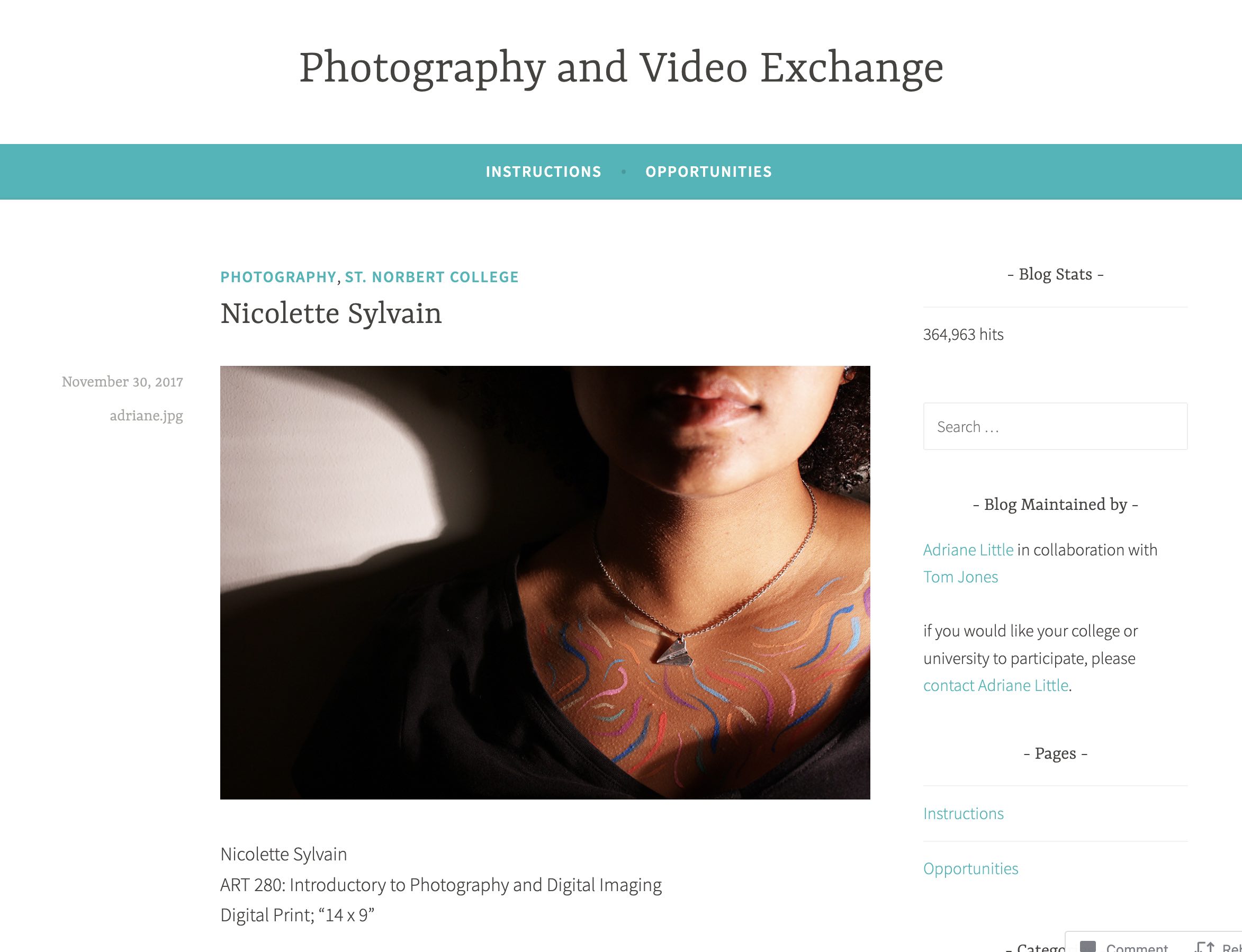
Screenshot From the Photography and Video Exchange Site
St. Norbert College students have participated in the Photography and Video Exchange Blog for several years. It is a great project started by Adriane Little (Western Michigan University) in collaboration with Tom Jones (University of Wisconsin–Madison). The blog features student photography and video projects accompanied by brief statements about the work. St. Norbert students have contributed both photography and video, with new work scheduled to be posted this fall!
The exchange includes contributions from a wide range of institutions, including several University of Wisconsin campuses, Binghamton University, Mississippi State University, the University of Kentucky, other liberal arts institutions, art schools such as the Maryland Institute College of Art, international institutions including Otterbein University and the University of Toronto, as well as community colleges and technical colleges. It provides a valuable cross-section of contemporary student work and offers a great view into the current state of photography education.
You can search by school to see what students are doing at each participating campus. Check it out! Here is the link to the SNC posts!
Although the coming of fall this year has been somewhat unreliable of late, you can count on the changing of the exhibitions here at the SNC Art Galleries to be dependable and swift.
We have two new exhibitions this month, each with their own enticements and merits. Read on below to discover what’s new and get the details for this month’s gallery reception.
Baer Gallery
The Baer Gallery currently holds the exhibition Johanna Winters: What the Pleasures Told Us. Winters, as she tells us in her artist’s bio available on her official website, “hails from Minneapolis, MN and received her BA from the University of Wisconsin…In her work she applies modes of printmaking, hand-driven animation, and puppetry to consider ideas about vanity and shame.” Her work in this particular exhibition, as she tells us in her artist’s statement available for viewing at the exhibition, “…behaves as coping rituals for anxieties about aging, vanity, disappointment, shame, and pleasure.” Winter’s is currently working towards her MFA at the University of Tennessee-Knoxville
Winter’s exhibition at the Baer Gallery is guest-curated by Katie Ries, SNC Art Faculty member. Ries provides an insightful statement about Winter’s work also available for consumption at the gallery. One line in particular sums the mysterious and poetic work up beautifully: “This is how it feels to be human, coming up short, loving things, and figuring it out as we go along.”
Godschalx Gallery
This month the Godschalx Gallery features the show Graphic Design History & Rock and Roll. This show is comprised of work made by St. Norbert College art students. The show features dozens of original band posters, each variously influenced by a historical graphic design style. Some of the bands featured are well-known, and some come out of the imaginations of the students themselves.
Each poster in the show is impressive by itself, but collaged together in one space they present a power-punch of movement and color that is not to be missed.
Gallery Reception
A reception for both of these shows will be held on October 19, from 5-7p.m. and will feature a performance art piece by Johanna Winters. Light food will be available as well as wine for those of age. All of us at the gallery bid you welcome and hope to see you there!
There was much to see, learn, and make in the Bush Art Center on SNC Day this past Saturday! Here are a few highlights:
Volunteers Coneria Nansubua and Emma Hanson demonstrating the flower making project to visitors.
Detail image of a wall piece by April Beiswenger
Visitors made flowers out of organic cotton and recycled t-shirt fabric. The project was inspired by a piece in the April Beiswenger: 1000 T-Shirt Project exhibit.
Visitors waiting to tour the tiny house on display as part of the Shelter and Clothing exhibit.
Rebecca Rutter, tiny house owner, designer and builder, gave tours of the house from 10:00 a.m. until 5:00 p.m. The house drew a lot of interest with steady waiting lines all day long. In case you missed it, there are three more days to tour the house! Open house hours are Wednesday, noon- 2 p.m., Thursday, noon-2 p.m. and Friday, 11:00-1:00 p.m., through Friday, Sept. 23.
Garments by Alabama Chanin on exhibit in the Baer Gallery
Map piece by April Beiswenger on exhibit in the Godschalx Gallery
On display throughout the day were, among other artworks, gorgeous hand-sewn garments by Alabama Chanin in the Shelter and Clothing exhibit and a map piece illustrating where t-shirts are made in the 1000 T-Shirt Project exhibit.
SNC alum, Hannah Kestly and student, Maria Deau visiting with professor Ben Chan in the Boot Making Workshop
A full shop!
Professor Ries and her son at the boot workshop.
A lot of boot making fun happened in the critique studio. SNC students and alums helped visitors craft boot models and handed out screen prints. The project was designed by professor Katie Reis and student collaborator, Maria Deau.
Creating tiny house designs
Tiny house drawings
Kids stopped in the Baer Gallery to draw their own tiny house designs.
Other events throughout the day included Art and Design lectures presented by Art professor, Fr. Jim Neilson and Theatre professor, April Beiswenger. Cheers to another great SNC Day!